
Digital donation solutions for Zakat, Sadaqah & Ramadan campaigns
Most Muslim charities and mosques are at their busiest during Ramadan. The volume of giving can increase dramatically during Ramadan and rise again during the final ten days, with many donors focusing particularly on Laylat al Qadr. The challenge is not a lack of generosity, but whether a charity is equipped to make giving easy when donors are ready to give.
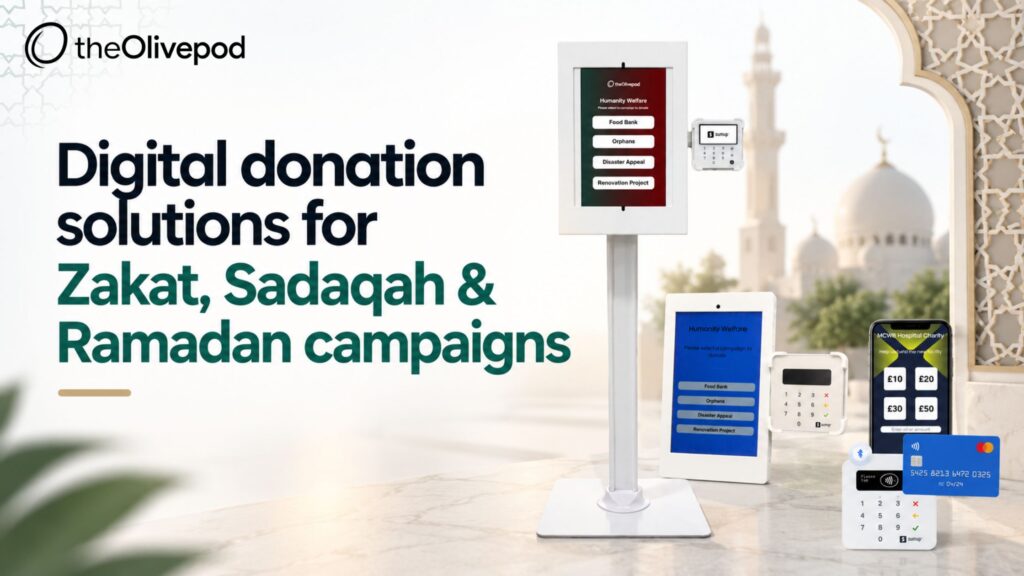
A mosque or Islamic charity that continues to depend primarily on collection boxes and cash trays risks leaving an increasing number of potential donors with no convenient way to give. Contactless kiosks, mobile readers, QR codes and online giving pages can bridge that gap without asking donors to change their habits.
Why do mosques and Muslim charities need digital donation tools?
Classical collection techniques were designed for a cash first world. Donors are now willing to donate in a couple of taps, at any hour, without having to look around for notes or coins. Digital donation tools can help charities and mosques in several ways.
- Take gifts at any time, whether during Jummah, taraweeh or suhoor, without relying on a person with a collection tin.
- Reach donors outside the congregation, including those who come in person, view an appeal online, or learn about a campaign second hand.
- Reduce the time spent counting, banking and reconciling donations. This can save valuable volunteer time, particularly during Ramadan when staff and volunteer demands are at their peak.
- Build donor trust with instant confirmations, rather than leaving donors with only the memory of placing a coin in a collection box.
- Charities can reduce the risk of storing cash overnight on their premises, especially during seasons when they collect donations night after night.
Charities risk losing donations when their donation tools fall behind, simply because supporters find giving too slow or miss the opportunity to donate before finding cash.
Where should mosques and charities place donation points during Ramadan?
Placement can determine how much goodwill is translated into actual giving.
On the way into and out of the prayer hall
Many donors make their contributions when the message of the sermon or dua is still fresh in their minds. A terminal in this location can capture that moment of generosity.
Close to the iftar and suhoor serving areas
Community meals attract large numbers of people who may already be in a giving state of mind. A mobile card reader can turn a group meal into an opportunity for group giving.
On posters and appeal materials
On a leaflet, banner, or social post, a QR code allows someone to contribute the moment they read your Ramadan or Qurbani appeal. No terminal is required.
On your social sites and webpage
Online giving pages can receive donations from people who share appeals online, including supporters who are not physically present at the mosque.
Can contactless giving increase donations compared with cash collections?
Contactless giving can make it easier for donors to give, particularly when they do not have cash with them. With a cash collection, donors are limited to the notes or coins they happen to be carrying. A contactless terminal gives donors the option to choose an amount that reflects what they would like to contribute.
Recommended donation amounts can also make the decision easier by giving donors a clear starting point. Instead of deciding how much to give without any guidance, donors can choose from suggested amounts or enter their own figure. This can reduce friction and make it easier to turn an intention to give into an actual donation.
The pool of potential donors is also larger. A cash tin can only be accessed by people who have cash with them on a given night. A tap to donate terminal can connect with anyone who has a card, phone, or watch, including guests, visitors, and non regular attendees who have come to a particular event.
For Ramadan campaigns in particular, specific asks can make the purpose of a donation clearer. Showing donors what £5 or £10 can provide, such as an iftar meal, a portion of fidya, or part of a Ramadan food parcel, can help donors understand the impact of their contribution and make a quick, informed choice.
How can Zakat and Sadaqah giving be made easier without changing how donors calculate it?
Zakat is an obligatory religious duty with its own calculation, based on the particular assets of the donor and the nisab threshold. That calculation should remain with the donor or a trusted source that the donor relies on for religious guidance, rather than being handled by a payment terminal.
Digital tools can assist after the donor has determined how much to contribute. They can make the process faster, more secure, and easier to trace. That means:
A donor page or terminal that allows the donor to enter their own calculated figure easily, rather than relying only on pre-programmed amounts.
Clear categories for Zakat, Sadaqah, Fidya and Fitrana, allowing each type of giving to be recorded and reported separately. This is important for donor trust and charity accounting.
Immediate acknowledgement after a Zakat or Sadaqah payment, giving the donor an email receipt to keep for their own records.
An easy way to establish recurring Sadaqah, for donors who want to give regularly in smaller amounts.
Presented in this way, the technology supports the donor’s giving without replacing their own religious judgement about what they should give.
How can Ramadan campaigns handle peak giving without slowing down?
Ramadan is associated with a significant increase in giving and many systems need to be prepared to handle this demand. Digital donation tools can help charities manage the increase instead of being overwhelmed by it.
Process more transactions during peak nights, particularly during the last ten nights, without terminals slowing down or creating queues.
Record Fidya, Kaffarah and Fitrana separately rather than placing them under general Sadaqah, so reporting remains accurate.
Show live progress for specific appeals, which can help build momentum as a campaign approaches its target.
Send automated Gift Aid receipts to eligible UK donors, helping charities claim additional income that would be difficult to recover from cash donations.
Allow staff to update campaign messaging across all terminals and pages from a single dashboard. This means a new appeal can be activated within minutes rather than requiring someone to physically update every collection point.
What should a mosque or charity check before choosing a donation platform?
Look at the complete cost, including hardware, monthly subscription fees and transaction pricing, rather than focusing only on the headline price. When the number of small gifts is high, per transaction rates become particularly important, especially for regular Sadaqah.
Ensure the provider is PCI and GDPR compliant and accepts Apple Pay, Google Pay, and regular cards. During Ramadan, donors will often choose whichever payment method is fastest and most convenient for them at the time.
Prioritize ease of use. Volunteers operating a Ramadan bazaar stand or a booth at the mosque entrance will have little time for training, so the system should be simple to operate. Remote campaign management is useful here as well. Being able to launch or update an appeal across all your devices at the same time allows your team to respond to what is working in real time throughout the season.
Lastly, look for short term and flexible contracts. Some charities only need additional terminals during Ramadan, so a strict annual contract may not suit their needs.
FAQs
What is the distinction between Zakat and Sadaqah?
Zakat is mandatory yearly giving by a donor who meets the qualifying wealth requirements, calculated against the nisab threshold. Sadaqah is a voluntary charity that can be given at any time and in any amount.
May I pay Zakat or Sadaqah using a contactless terminal?
Yes. A donor can use a calculator or trusted religious guidance to calculate their own Zakat amount and then enter or choose that amount when making the payment. The terminal simply makes the payment fast, secure and recorded. It does not perform the Zakat calculation itself.
Why do donations increase during Ramadan?
It is believed that good deeds are more greatly rewarded during Ramadan, particularly during the final ten days. This encourages many people to increase their giving during Ramadan.
Is it permissible to pay Zakat and Sadaqah through the internet or using a card?
Yes, provided the platform processes payments through a secure, encrypted system and an established, transparent organisation operates it.
Is it possible to establish Sadaqah in a recurring form for donors?
Yes. Most online donation solutions allow donors to set up recurring gifts on a weekly or monthly basis.
Final thoughts
Digital donation solutions do not need to determine how much Zakat a donor should give, and they cannot replace that religious judgement. The amount is a matter of personal religious duty. The role of digital donation technology is to remove friction between the decision to give and the moment when the donor actually gives. There is no need to have cash available, wait in a queue, or wait until getting home and risk forgetting to donate.
For mosques and Muslim charities, this gap is particularly noticeable during Ramadan, when generosity is at its highest, and the impact of losing even a small percentage of potential donations because of unnecessary friction can be significant.
When your organisation needs to make Zakat, Sadaqah and Ramadan giving quicker and safer for your donors, call theOlivepod today to see how our contactless kiosks, mobile readers, QR codes and online giving services can help make your next campaign more effective.