
Digital fundraising for food banks
Solving the cash problem in crisis settings
Food banks are under increasing pressure. Demand is rising, operating costs are increasing, and some of the traditional fundraising methods that have helped keep shelves stocked are becoming less effective.
The collection box at the supermarket entrance, the cash box at the community centre and the sponsored walk with a bucket at the finish line all depend on people carrying coins and notes. Increasingly, they do not.
For food banks, this creates a simple but important problem. People still want to give, but the way they donate is changing. Digital fundraising can help close that gap.
Why is cash becoming a problem for food banks?
The UK has rapidly moved towards digital payments. People increasingly use cards, phones and smartwatches to pay for everyday purchases, from weekly shopping to coffee and public transport.
As a result, fewer people carry cash with them.
For food banks, this creates an uncomfortable disconnect. The willingness to donate may be there, but the method of donating no longer matches the way people pay.
Imagine a shopper leaving a supermarket after seeing a food bank collection point. They want to help, but they have no cash in their wallet. They may make a mental note to donate later, but that moment of goodwill can easily disappear.
That is a donation potentially lost because of friction, not a lack of generosity.
Cash also creates additional work for food banks. Volunteers may need to collect, count, record, transport and bank donations. Cash handling can also create security concerns, particularly for smaller organisations operating from community buildings.
Digital giving can reduce some of this administration while making it easier for supporters to donate when they feel motivated to do so.
What does digital fundraising look like for a food bank?
Digital fundraising means giving supporters convenient ways to donate without needing cash. For food banks, this can take several forms.
Contactless donation terminals
Contactless terminals allow supporters to tap a card, phone or smartwatch to make a donation in seconds.
Permanent terminals can be placed in food bank reception areas, partner supermarkets, places of worship and community hubs.
Mobile card readers
Mobile card readers allow volunteers to accept donations at events and collection points. They can be used at harvest festivals, school events, community activities and other fundraising occasions.
This means a volunteer does not need to rely on supporters having cash available.
QR codes
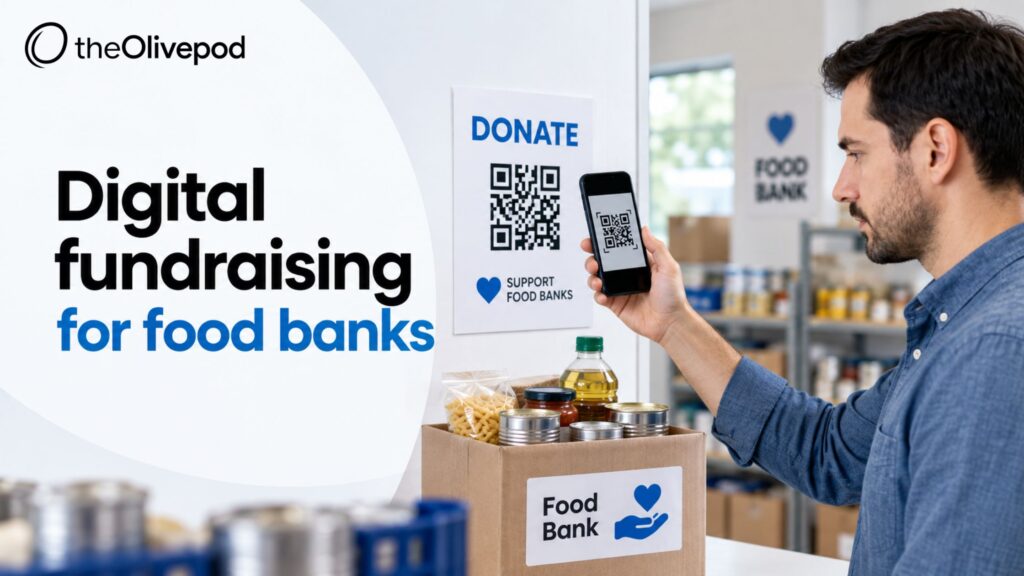
QR codes can be added to posters, collection points, leaflets, social media posts and food bank vehicles.
A supporter can scan the code with their phone and go directly to a donation page without needing a card terminal.
Online giving
Online donation pages and website widgets make it easy to accept donations from social media campaigns, email appeals, local media coverage and the food bank’s own website.
Used together, these options create multiple ways for people to support a food bank wherever they encounter its work.
Where should food banks place donation terminals?
The location of a donation terminal can be just as important as the number of terminals available.
The strongest locations tend to combine high footfall with a natural connection to the cause.
Supermarkets
Supermarket collection points are an obvious opportunity. Shoppers are already thinking about food, so a contactless terminal beside a food donation trolley can give people another way to help.
Someone who forgot to buy an extra tin can still make a financial contribution before leaving the store.
Places of worship
Churches, mosques and other places of worship can be valuable locations for digital donation points. Congregations may include regular supporters who are increasingly unlikely to carry cash.
Community spaces
Libraries, community centres, partner cafés and other local venues can help food banks reach people during their everyday activities.
Food bank reception areas
Reception areas can provide another useful opportunity. Visitors may include volunteers, referral partners, local businesses and community supporters who want to contribute after seeing the work being done.
The message displayed on a terminal also matters.
Specific messages tend to be more compelling than generic requests for support. For example, explaining what a particular donation could help provide gives supporters a clearer understanding of the impact of their contribution.
Instead of simply asking someone to “support our food bank”, a message could explain that a £5 donation could help provide items for an emergency food parcel.
Can contactless giving increase donation values?
Contactless giving can help food banks increase both convenience and the potential value of individual donations.
Cash donations are often limited by whatever someone happens to have in their wallet or pocket. A supporter may want to give £5 but only have a few coins available.
With a contactless terminal, the supporter can choose from suggested donation amounts such as £3, £5, £10 or £20.
The wider benefit is accessibility. Anyone with a suitable card or mobile device can potentially donate without needing to carry cash.
Digital giving can also create an opportunity for recurring donations.
After making a one off donation, supporters can be encouraged to make a small monthly contribution. For food banks, predictable recurring income can be particularly valuable because it makes it easier to plan for stock purchases, staffing and other ongoing costs.
How can Gift Aid increase digital donations?
Gift Aid allows eligible UK charities to claim an additional 25p from HMRC for every £1 donated by a qualifying UK taxpayer, provided the relevant conditions are met.
Collecting the information and declarations needed for Gift Aid can be more difficult when donations are made anonymously through a traditional collection bucket.
Digital donation platforms can make the process easier by incorporating Gift Aid prompts into the donation journey and securely recording the required information.
For a food bank receiving £40,000 in eligible donations, successful Gift Aid claims could provide a significant additional source of income.
The key point is that Gift Aid should not be treated as automatic. Food banks need to make sure their donation process collects the information and declarations required for eligible claims.
What should food banks consider before going digital?
Choosing a digital fundraising system is not just about buying a contactless terminal. Food banks should consider the full cost and practical requirements of the system.
Total costs
Look at the complete cost, including hardware, subscriptions and transaction fees.
Transaction charges are particularly important when the average donation value is relatively small.
Payment options
The system should support the payment methods supporters are most likely to use, including contactless cards, Apple Pay and Google Pay where supported.
Security and compliance
Food banks should check that their provider follows appropriate payment security and data protection requirements, including relevant PCI DSS and UK GDPR obligations.
Ease of use
Volunteers are often busy and have different levels of technical confidence. A fundraising system should be simple enough to operate without extensive training.
Remote campaign management
Remote management can be particularly useful for food banks running seasonal or emergency appeals.
Being able to update messages across multiple devices from one dashboard means a food bank can respond quickly to events such as winter pressures, harvest campaigns or sudden increases in local demand.
Flexibility
Smaller food banks may not want to commit to a long contract before they know whether digital fundraising will work for them.
Shorter or rolling contracts can give organisations the flexibility to test the approach, measure results and expand when it makes sense.
Conclusion
Food banks cannot afford to lose potential donations simply because someone does not have cash with them.
Digital fundraising removes some of that friction. Contactless terminals, mobile card readers, QR codes and online giving can give supporters more convenient ways to donate while reducing some of the administration associated with cash.
Digital systems can also create opportunities for recurring donations and make it easier to incorporate Gift Aid into the donation journey.
For food banks, the goal is not necessarily to replace every traditional fundraising method. It is to make sure that people who want to help have a simple way to do so.
Platforms such as theOlivepod bring different digital fundraising tools together in one system, giving food banks a practical way to modernise their fundraising while keeping the process simple for staff, volunteers and supporters.
When communities need support, making it easier to give can help food banks turn more moments of goodwill into meaningful, sustainable income.
Frequently Asked Questions
Can food banks accept contactless donations?
Yes. Food banks can use contactless donation terminals and mobile card readers to accept donations by card, phone or smartwatch. This gives supporters a convenient way to donate even when they do not carry cash.
How can food banks raise money without cash?
Food banks can use several cashless fundraising methods, including contactless donation terminals, QR codes, online donation pages and mobile card readers. These can be used in supermarkets, community centres, places of worship, events and other fundraising locations.
Can food bank donations qualify for Gift Aid?
Yes, eligible donations can qualify for Gift Aid when the donor meets the requirements and provides the necessary declaration and information. Digital donation platforms can make it easier to collect and manage this information as part of the donation process.
Can food banks accept recurring donations online?
Yes. theOlivepod Online giving can give supporters the option to make regular monthly donations through Stripe. Recurring income can help food banks plan more confidently for ongoing costs such as food supplies, staffing and operations.
Are QR codes useful for food bank fundraising?
Yes. QR codes can give supporters a quick route to an online donation page. They can be placed on posters, collection bins, leaflets, social media posts and food bank vehicles.